Table of Contents
ToggleA finished basement doesn’t require a six-figure renovation budget or a contractor’s crew. Many homeowners overlook their basement as untapped living space simply because they assume a full remodel is beyond reach. The truth? Strategic, budget-conscious improvements can transform a dark, dingy basement into a functional guest suite, home office, or recreation area. This guide walks you through seven practical small basement remodel ideas that deliver real impact without very costly. From lighting and paint to storage and flooring, these projects focus on cost-effective solutions that any DIYer can tackle.
Key Takeaways
- Small basement remodel ideas can transform dark, dingy spaces into functional guest suites or home offices without requiring a six-figure budget when you focus on strategic, cost-effective improvements.
- Light-reflective paint colors with an LRV above 60 and semi-gloss finishes are the cheapest way to reshape a basement’s mood while improving moisture resistance and light reflection.
- Maximize natural light by upgrading egress windows ($400–800), adding mirrors to bounce light into dark corners, and replacing heavy furniture with open shelving that doesn’t block light.
- Invest in layered lighting with recessed lights ($300–600 for 6–8 fixtures), task lamps, and LED bulbs at 4000K color temperature to brighten spaces affordably and energize the environment.
- Define functional zones using area rugs, paint accents, and strategic furniture placement rather than walls, allowing you to create a multi-purpose basement even in limited square footage.
- Choose moisture-resistant flooring like sealed concrete, luxury vinyl plank ($1–4 per square foot), or tile, and test moisture levels before installation to prevent costly repairs and mold issues.
Maximize Natural Light Without Major Structural Changes
Basements suffer from darkness, and darkness kills the entire feel of a space. Before you reach for expensive skylights or cutting new windows, explore low-cost light-maximizing tactics.
Start with egress windows. If your basement has foundation walls with window wells, upgrading to larger egress units isn’t cheap, but it’s far cheaper than structural work. A standard egress window replacement runs $400–800 per opening, and you’ll get dual benefits: more natural light and a required emergency exit for bedrooms (per most building codes).
If egress windows aren’t feasible, focus on what you can control. Paint walls and ceilings in bright, light-reflective colors (covered in the next section). Swap dark wood shelving for open wire or metal racks that don’t block light. Remove heavy curtains and install cellular shades or roller blinds that diffuse light rather than block it.
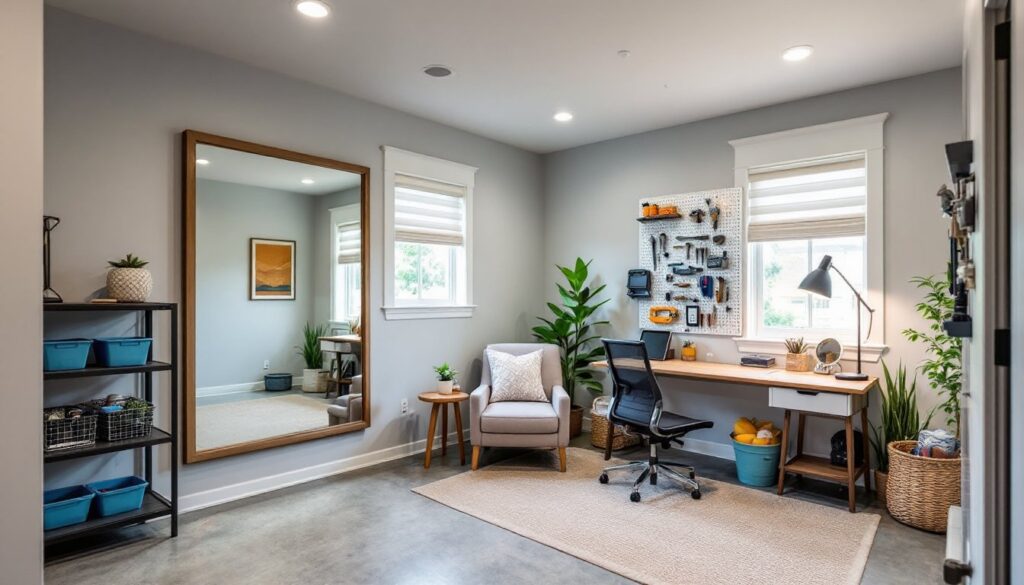
Consider reflective surfaces: polished concrete floors, light-colored area rugs, and strategic mirrors amplify whatever light enters. A large mirror opposite a small window effectively doubles perceived brightness and doesn’t require any permits. Position mirrors to bounce light toward dark corners and the center of the room.
For safety and aesthetics, general home remodeling spans many disciplines, some as simple as repositioning furniture and mirrors to improve sightlines and flow.
Choose the Right Paint Colors and Finishes
Paint is the cheapest, fastest way to reshape a basement’s mood. Don’t default to builder white, pick colors strategically.
Light, cool-toned paint (soft grays, pale blues, or warm whites with LRV, light reflectance value, above 60) makes small basements feel larger and less cave-like. Avoid heavy, dark colors unless you’re painting a single accent wall. A gallon of quality interior paint covers roughly 350–400 square feet and costs $25–50, so even a full basement walls-and-ceiling job runs $150–300 in materials.
Choose a semi-gloss or satin finish instead of flat. Semi-gloss reflects light (critical in basements), resists moisture better, and cleans easier. Flat paint absorbs light and grabs dirt: it’s not ideal for basements, especially below grade where humidity fluctuates.
Before painting, address moisture. If walls show efflorescence (white, powdery deposits) or dampness, primer won’t stick and paint will peel. Seal cracks with concrete crack filler and let cure fully. Use a moisture-blocking primer rated for below-grade use, brands like Kilz and Zinsser make solid options. This step costs an extra $15–20 per gallon but prevents repainting in two years.
Test paint samples on large poster board and observe them at different times of day. Basement lighting is artificial, and colors shift dramatically under overhead fixtures versus natural window light.
Smart Storage Solutions for Compact Spaces
Basements are junk drawers. Clutter kills the vibe faster than poor lighting. Smart storage isn’t fancy, it’s just honest organizing.
Open shelving along walls (metal or wood studs) costs $50–150 per shelving unit and stores far more than closed cabinets while keeping the space visually open. Use labeled bins and baskets for small items. Wall-mounted shelves above utilities or to the side of the furnace reclaim dead space without eating floor area.
Consider vertical storage: pegboards, slatwall, or simple wooden battens on studs hold tools, seasonal items, or craft supplies 6–7 feet up, leaving floor space free. A pegboard kit costs $30–60 and installs in an afternoon with basic tools.
Built-in shelving around the perimeter (even simple floating shelves) defines the room and keeps clutter off the floor. If you’re painting, match shelf colors to walls to create visual continuity. Avoid random, standalone furniture, it breaks up small spaces and collects dust.
For items you want hidden, invest in one or two matching storage cabinets or wardrobes (IKEA PAX units or similar). Group storage to one wall rather than scattering it. This visual discipline makes even a packed basement feel organized.
Use resources like home design ideas on Houzz to see how other homeowners have tackled storage in tight quarters. Seeing real examples often sparks practical solutions tailored to your layout.
Affordable Flooring Options That Transform Basements
Concrete subfloors are cheap but uninviting. You don’t need carpet to make a basement feel warm.
Sealed concrete is the most affordable finish. A concrete sealer ($30–50 per gallon) penetrates the surface and hardens it, making it easier to clean and slightly more stain-resistant. Polished concrete adds visual interest (costs $2–12 per square foot for professional work, or you can rent a polisher for $50–100 per day and DIY). Staining concrete ($0.50–3 per square foot) adds color depth without the cost of new material.
Luxury vinyl plank (LVP) flooring is durable, moisture-resistant, and costs $1–4 per square foot installed (or $0.50–2 DIY). It mimics wood or stone convincingly, installs with a click-lock system (no adhesive), and hides easily under area rugs if you want softness. For a 400-square-foot basement, expect $200–800 in materials.
Ceramic or porcelain tile is water-proof and lasts forever but requires grout maintenance. Budget $3–10 per square foot for tile and installation. If moisture is a concern, tile is your safest bet, though it feels cold. Warm it with area rugs in seating zones.
Avoid traditional wall-to-wall carpet in basements unless moisture is completely controlled (dehumidifier running year-round). Carpet traps moisture and harbors mold. If you want softness, use a large area rug over sealed concrete or LVP, it’s cheaper to replace and easier to troubleshoot if mold appears.
Always test moisture levels before installing any flooring. Use a calcium chloride test kit ($10–20) to measure concrete moisture vapor transmission. High readings mean you need a dehumidifier or moisture barrier before flooring goes down.
Create Functional Zones in Limited Square Footage
A basement is only useful if it does something. Don’t just finish it, program it.
Define zones without walls. Use area rugs, paint, and strategic furniture placement to carve a basement into distinct areas: a seating nook, a work station, a storage wall. A 300-square-foot basement might be 70 square feet of lounge (sectional or two chairs and a small table), 80 square feet of workspace (desk and filing storage), and 150 square feet of open flex space or storage.
Ceiling height and ducting constrain basements. Note where HVAC ducts, water lines, and electrical conduit run before placing tall furniture or shelving. A standard basement ceiling is 7–8 feet: obstructed headroom feels cramped. Keep seating and low-profile storage in areas with ductwork overhead.
Create a focal point: a small media wall with a TV, a work wall with pegboard and task lighting, or a reading nook with a bookshelf and comfortable chair. A focal point gives the space purpose and makes even a small basement feel intentional.
Zoning is free. Move items around, reposition furniture, and test layouts. Paint an accent wall or lay down an area rug to anchor a zone. These cost nothing and help you visualize the final space before committing to permanent changes.
Projectslike basement bars, rec rooms, or guest suites are detailed in remodeling guides on This Old House, where you’ll find step-by-step instructions for finishing basements to code.
Lighting Upgrades That Brighten and Energize
Basement lighting often relies on a single overhead fixture, dim, institutional, and soul-crushing. Upgrade thoughtfully and affordably.
Recessed lighting (cans) are standard basement upgrades. New cans cost $15–40 each: trim, housing, and bulbs add another $20–50 per fixture. For a 400-square-foot basement, 6–8 recessed lights ($300–600 total) provide good ambient coverage. Hire an electrician if you’re not confident running wiring, this is not a cutting-corner area. Permit requirements vary by jurisdiction: check with your local building department before starting.
LED bulbs are non-negotiable. They cost $5–15 per bulb but last 25,000+ hours and use 75% less energy than incandescent. Choose 4000K color temperature (neutral white) for basements: it feels energizing without the harshness of 5000K+ daylight tones.
Layered lighting is key: ambient light (overhead), task light (desk or workbench), and accent light (wall sconces, floor lamps). A floor lamp in a dark corner ($30–80) transforms that zone instantly. A desk lamp ($20–60) makes a workspace livable.
Smart bulbs and dimmers add flexibility. Color-tunable LEDs let you shift tone from warm (2700K) in evenings to cool (4000K) during the day, matching your mood and activity. A basic dimmer switch costs $15–30 and installs in minutes (swap a standard switch).
Resources like ImproveNet’s cost guides break down electrical upgrade budgets and help you plan lighting layouts that match your space and wallet.
Conclusion
A basement remodel doesn’t demand deep pockets or months of construction. Strategic improvements, better light, fresh paint, smart storage, and intentional zones, transform unused square footage into functional living space. Start with moisture assessment and surface prep, then layer improvements in order of impact and budget. Focus on what you can DIY (painting, storage, zoning) and outsource what requires permits or expertise (electrical, structural, windows). Your basement is a goldmine waiting to be activated.